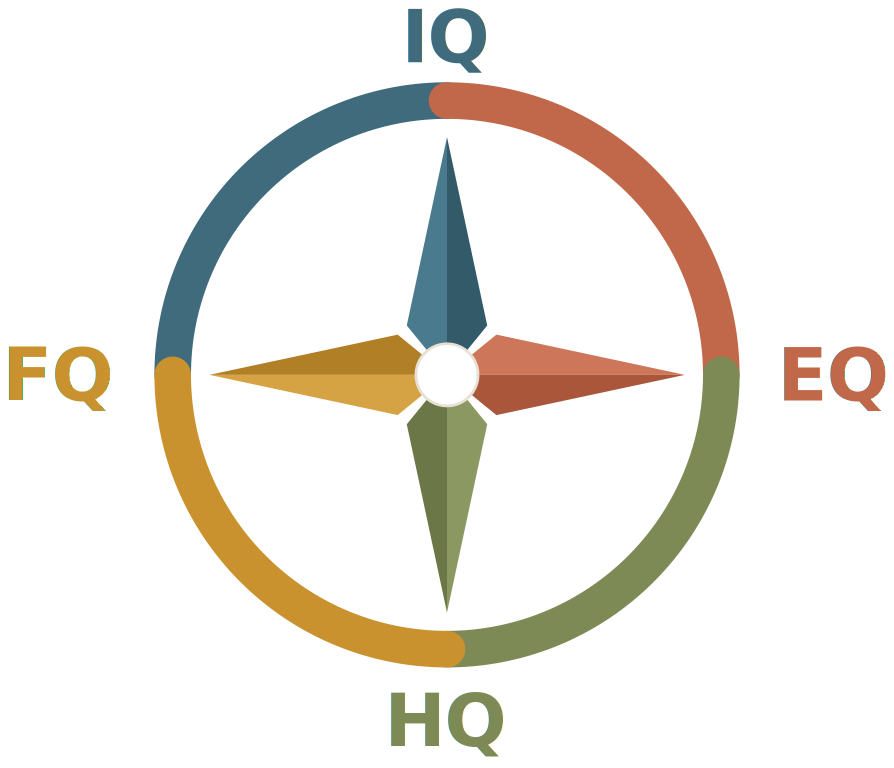
The 4Q Framework

IQ

Intellectual Growth

Learning & Growth

A mind that keeps growing

IQ here is not a test score. It is Intellectual Growth: a capacity you cultivate, not a number you are issued.

A mind that keeps growing stays relevant, adaptable, and awake to opportunity. The four intelligences are how you live the life you truly want, anchored in who you authentically are. IQ is the first direction on that compass — toward learning and growth.

The goal is not to accumulate knowledge for its own sake. It is to think clearly and independently, learn continuously, and pursue mastery in the areas that matter — to you.

Discover before you acquire. Strengths and passions are already in you. Learning and curiosity put them to work.

3 Pillars

Where IQ is built

1

Strengths & Passions

Build on what you're naturally good at and love.

Not all effort produces equal growth. Weaknesses sometimes have to be managed. The greatest progress tends to come where strengths and interests already exist.

Strengths develop more naturally. Passions supply the energy to stay with the work. Where they meet, learning accelerates — and time can pass without your noticing. That is flow: skill and challenge closely aligned.

These two circles are yours. They are also two of the four that make a sweet spot. This pillar is narrower: get sharper in the ingredients you actually own. Consistent practice turns a direction into a distinctive way of working — something others recognise and seek out.

Unless that picture is already clear, begin with awareness. What leaves you energised? What do you do easily that others find hard? What do people already come to you for?

2

Lifelong Learning

Invest in continuous growth and new perspectives.

If strengths give direction, learning gives expansion.

Formal education often implies that learning has an endpoint. Degrees finish, careers begin, horizons narrow. The modern world rewards the opposite habit: treating learning as permanent.

Abilities can keep growing through effort, practice, and reflection. Most of that growth does not happen in a classroom. A useful directional guide: much of it comes from real work and real challenges, some from people — mentors, peers, honest conversation — and only a little from formal courses. Consistency and an open mind matter more than intensity.

Twenty to thirty minutes of focused reading or study each day can accumulate into substantial knowledge over time. It is not about large swaths of time. It is about returning.

3

Curiosity & Great Questions

Stay agile, and seize new opportunities.

Curiosity is the engine. Knowledge can sit there; curiosity keeps the process alive.

Curious people are less satisfied with surface explanations. They want to know how things actually work. Genuine curiosity also makes learning stick — and it is often a question, not an answer, that moves a conversation.

Questions worth keeping close:

  • What problem are we really trying to solve?
  • Why do we assume this approach is the best one?
  • What would happen if we tried something completely different?

In a moment of new ideas, it helps to find the merit first: what is positive, what opportunity it might open, what issues need work, and what new thinking would resolve them. Sequence matters. Critique comes after curiosity, not before.

Information has never been easier to reach. Judgment — and the questions that develop it — is the scarce part.

In practice

How it shows up in a day

Intellectual growth rarely arrives as a dramatic leap. It shows up in ordinary hours.

A stretch of work that matches what you are good at and actually care about: the clock moves differently. A protected twenty or thirty minutes with a book, a problem, or a conversation you are genuinely in. A meeting in which someone asks the question everyone else skipped. An idea met with interest before it is taken apart.

Treat the day as a classroom without turning it into a course. A difficult task, a conversation that surprises you, a page you almost did not open — each is a chance to stay awake. Small habits, practised consistently, change how you understand the world, and how you contribute to it.

One dimension is enough to begin. You do not have to rebuild a mind in a week.

The compass

Find your position

A compass does not tell you where to go — your vision does. It tells you where you are, and which direction needs attention now.

If you want a structured look at all four intelligences, the 4Q Self-Assessment is a personal reflection tool. Three statements per intelligence. Scores and notes stay in the browser on this device. Nothing is sent. The aim is not perfection. It is awareness of where energy is flowing, and where it may be worth placing more.

The 4Q Compass app is a daily journal for the same four dimensions: a quiet morning intention, an honest evening reflection. It is a mirror, not a coach. Free, built for iPhone, and your data stays on your device. Its daily scores use a different scale from the assessment — they are not the same instrument.

Start with IQ if this is the direction that has gone quiet. Or notice which of the four is actually asking.

Next: EQ — Emotional Intelligence · Relationships & Joy

Occasional notes

News about the 4Q Framework, when there is some.

If a growing mind is something you want to keep tending, leave an address.

Check your inbox and tap the confirmation link. Until you confirm, you are not on the list. That is the EU double opt-in.

One email. When there is news. That is the whole deal.

4Q Compass — a free daily journal on iPhone