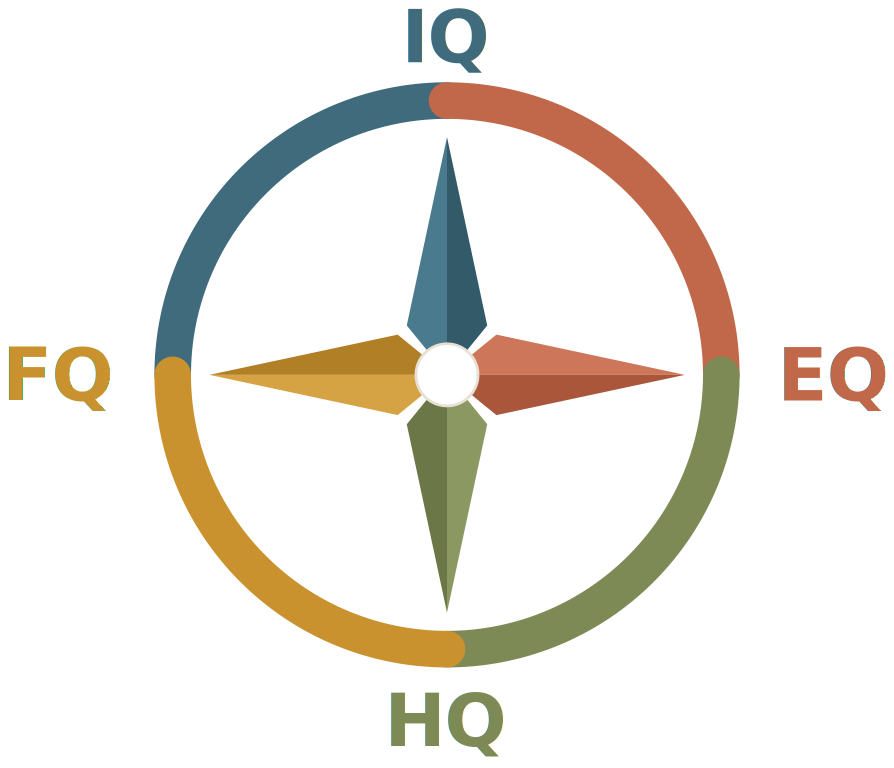
The 4Q Framework

FQ

Financial Intelligence

Security & Freedom

Security, then freedom

Financial intelligence is not the pursuit of wealth for its own sake. It is economic agency: the ability to shape a life with more freedom and more resilience.

Money is a medium of exchange. A tool. In many cultures it is still easier to stay quiet about it than to look at it clearly. School teaches currency and change. It rarely teaches personal finance, investing, or ownership. Most adults, even in wealthy societies, struggle with compound interest, inflation, and diversification. This is not a private failing. It is a gap. In an ageing society, security can no longer be fully delegated to an employer, a state, or chance.

FQ takes what your sweet spot can earn and puts it to work. It lets intellectual growth proceed without constant financial pressure. It steadies family life. It makes health, experiences, and meaningful work easier to choose.

Mastery creates control. Investing creates growth. Ownership creates freedom.

3 Pillars

Where FQ is built

1

Master Personal Finances

Master your cash flow, budget, and spending.

Begin with awareness. What comes in, what goes out, what you own, what you owe.

Many capable people avoid that picture. Money carries emotional weight. Avoidance can feel easier than clarity.

One evening, after a first child was born, a simple spreadsheet was enough to list income, fixed costs, discretionary spending, savings, insurance, and debt. Two surprises: how much disappeared into small recurring expenses that had become invisible — and how much calmer the room felt afterwards. The picture was not perfect. It was clear. The fear of looking had been worse than anything in the numbers. Clarity is the antidote to financial anxiety.

Do not lean on willpower. Design systems that make the useful behaviour automatic. Pay yourself first: move a portion to saving and investing before the rest of the month happens, ideally on the day income arrives.

A widely used guideline — 50 percent essential, 30 percent discretionary, 20 percent saving and investing — is a starting shape, not a law. Circumstances differ. The principle does not: allocate on purpose.

Hold a buffer. Several months of living expenses in easy reach; three months is a personal minimum in the manuscript, not a universal rule. Borrow for things likely to grow in value; pay off high-interest consumer debt first. That interest is compounding in reverse.

2

Invest & Compound

Invest consistently and let compounding work for you.

Once you pay yourself first: invest. Not as speculation dressed up as wisdom.

An investment, in the old sense, promises safety of principal and an adequate return after thorough analysis. Everything else is a bet. For most people the reliable path is also the plain one: low-cost, broadly diversified funds; a fixed amount at regular intervals, regardless of the headlines; costs kept down; time left to do the work. Automate it so the decision does not depend on mood.

Compounding is the quiet force. Returns reinvested become the source of further returns. A simple illustration from the chapter: 100 euros a month at an average seven percent is about 30,000 euros after fifteen years, and more than 110,000 after thirty — of which only 36,000 were contributions. Time, not timing.

Starting early matters more than starting big. Patience, discipline, and temperament matter more than brilliance. Doing well with money has a little to do with how smart you are and a lot to do with how you behave.

Stay inside what you actually understand when you take more concentrated risks. A broad index fund does not require you to be an expert. A speculative corner does. Where you step outside that circle, do it deliberately, with money you can afford to lose.

3

Build Assets & Think Like an Owner

Build assets that create income and long-term wealth.

Employment is valuable. It also stops when you stop. Long-term independence needs a second engine: assets that generate income or appreciate without your daily hours.

Assets put money in. Liabilities take it out. The framing is simplified; the direction is still useful. Equities and funds. Property that earns. A stake in a business. Intellectual property. A venture that grows from what you know. Behind each sits the same shift: owner, not only consumer.

A consumer sees a brand; an owner asks how the business earns its margin. A consumer sees a salary; an owner asks how to participate in the value being created. A consumer sees spending; an owner sees capital to allocate.

The assets most worth building often sit closest to your sweet spot — the work you understand, care about, and can do well. Ownership is where financial intelligence and self-knowledge meet.

What this creates, in the end, is not merely wealth. It is freedom: to choose work that fits your values, to invest in family and health and growth, to take a risk without the whole structure depending on next month’s pay.

Financial security creates confidence. Investments create opportunity. Assets create freedom.

In practice

How it shows up in a day

FQ is mostly not a trading screen.

It is looking, once, at a picture you have been postponing. A standing order that moves money on payday before the month can argue. A month in which the 50–30–20 shape, or your version of it, is roughly true. An investment contribution that happens because the system ran, not because you felt brave. A slightly different question in an ordinary moment: how does this earn? Is this an asset, or only an expense?

You do not need a new personality. You need a clear picture, then one automatic habit. One dimension.

These ideas are general principles of financial literacy. They are not financial or investment advice. Markets involve the risk of loss. Circumstances vary. Speak with a qualified adviser before making significant decisions.

The compass

Find your position

A compass does not tell you where to go — your vision does. It tells you where you are, and which direction needs attention now. FQ neglected often shows up first as a vague unwillingness to look. Looking is the first practice.

The 4Q Self-Assessment has three statements on this dimension, with the other three. Scores stay on this device. Nothing is sent. Awareness before strategy.

The 4Q Compass app can sit beside that awareness: a daily journal across IQ, EQ, HQ, and FQ. A mirror, not a coach. Free on iPhone. Your data stays on your device.

If this is the quiet quadrant, begin here. If you have read the four pages in order, return to the framework and choose one dimension — only one — for the next stretch of days.

Next: 4Q Self-Assessment · A Personal Reflection Tool

Occasional notes

News about the 4Q Framework, when there is some.

If building real financial freedom is a project you're still working on, leave an address.

Check your inbox and tap the confirmation link. Until you confirm, you are not on the list. That is the EU double opt-in.

One email. When there is news. That is the whole deal.

4Q Compass — a free daily journal on iPhone