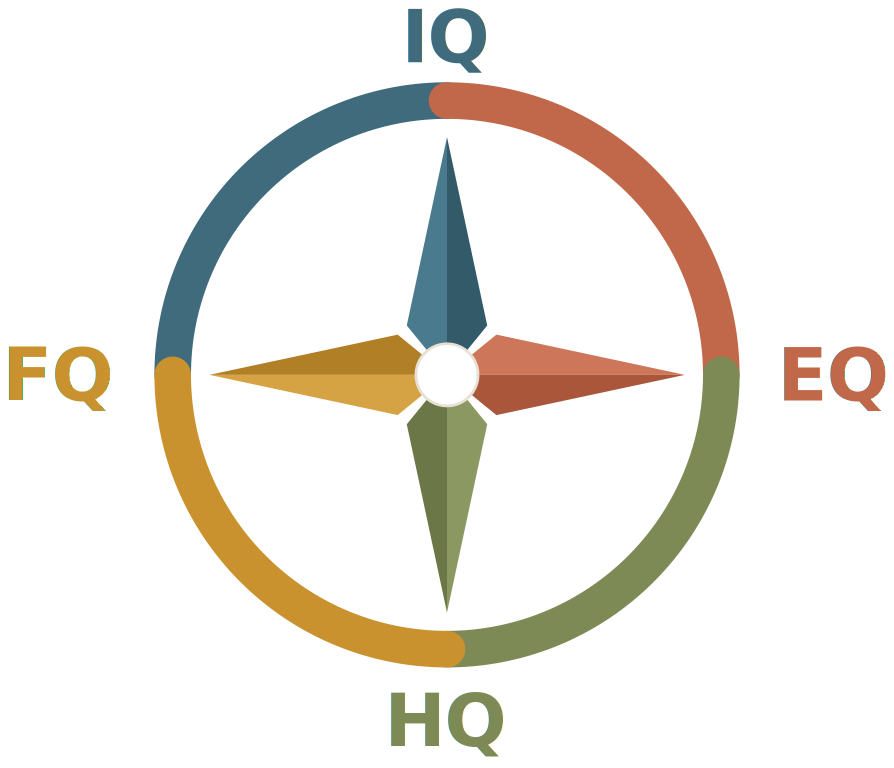
The 4Q Framework

EQ

Emotional Intelligence

Relationships & Joy

Relationships aren’t a reward

They are the life.

IQ shapes how we think. EQ shapes how we relate. Careers run on collaboration. Families and friendships hold belonging. Leadership depends on trust. Yet people who are highly capable intellectually still find themselves stuck in communication, conflict, or the simple difficulty of being present.

The longest study of adult life reached a conclusion so plain it is easy to dismiss: good relationships keep us happier and healthier. Not the number of connections — their quality. The sense that you can really count on the people in your life.

Joy rarely comes from isolated success. It arises in shared experience — laughter, trust, a conversation in which you are actually there. Emotional intelligence is how those conditions get built: not as a personality you either have or lack, but as practices you can learn.

Before the three pillars, one foundation: self-awareness. Notice what you are feeling before a difficult conversation, during it, and after. “Responsible” includes “response” and “able.” Become aware, and you become response-able. That inner work is what makes the rest possible.

3 Pillars

Where EQ is built

1

Positive Communication

Lead with warmth, openness, and a touch of humor.

Every conversation carries information and tone. Words change how people feel, how they read intention, and how they answer.

This is not about being merely correct, or merely persuasive. It is about clarity with respect and openness still intact. Positive communication does not mean avoiding difficult topics. It means approaching them with constructive intent.

Environments characterised by respect, openness, and psychological safety tend to collaborate more honestly. Defensive, dismissive, or cynical tone does the reverse.

Humor, used thoughtfully, lowers the temperature without shrinking the subject. Lightness is not the opposite of seriousness. Used well, it is what lets a serious idea land.

Over time, conversations of this kind produce something easy to miss: more moments of trust, and more shared joy.

2

Candid Feedback

Give and receive honest feedback that builds trust and fuels growth.

Growth requires honest input. Without it, we struggle to see how our actions land.

Feedback is often avoided anyway. People withhold it to keep the peace. People receiving it defend rather than get curious. What remains is polite silence.

Care personally and challenge directly, together. Care without challenge becomes saying what someone wants to hear. Challenge without care becomes technically honest and relationally costly. Both at once is what builds trust rather than breaking it.

A simple career-long rule: give feedback generously, accept it graciously. Aim for more reinforcing than developmental — not to bury the hard sentence in praise, but because genuine recognition is what lets the hard sentence land. The key words are candid and genuine. A compliment offered only to criticise is neither.

When you give it: ask permission; describe the situation and the specific behaviour; name the impact; check for understanding. When you receive it: listen before answering; ask; resist the instant defence; treat it as information, not a verdict; say thank you. Feedback is a gift.

3

Meaningful Relationships

Invest in the connections that matter most.

At its deepest, emotional intelligence is the ability to build and sustain real connection.

Belonging, support, and much of our sense of meaning come from other people. Strong relationships are not only comfort. They are a form of long-term well-being — and one of the primary sources of energy and joy.

They do not maintain themselves. They are built in one-to-one time, and in small deposits: truly listening, saying sorry, being kind, having patience. The deposit has to be sincere and non-transactional. Not a score. Not a debt. Presence, without a return ticket.

The relationships that matter most are often the obvious ones — family, a close friend, a trusted colleague. They can also be less frequent: a shared interest, common values, genuine sympathy. What they share is that they give energy. Intermittent contact can still be deeply personal, years on, if the connection was real.

In practice

How it shows up in a day

EQ is not a separate appointment. It is the climate of ordinary talk.

The tone you bring into a room. The pause before a hard conversation — what am I actually feeling, and why? A sentence of honest feedback offered with care, or received without a shield. A walk, a call, a meal in which you are not half elsewhere. A small deposit that no one asked for.

None of this requires a perfect social calendar. One candid exchange you have been avoiding is already a beginning. One dimension, one practice.

Joy, in this frame, is not a mood you manufacture. It is what healthy relationships tend to produce.

The compass

Find your position

A compass does not tell you where to go — your vision does. It tells you where you are, and which direction needs attention now. Deferred conversations rarely feel urgent one at a time. The accumulation is another matter.

The 4Q Self-Assessment asks three questions in this dimension, among the four. Scores stay on this device. Nothing is sent. The aim is awareness, not a grade.

The 4Q Compass app can hold the same attention day to day: morning intention, evening reflection, across all four intelligences. A mirror, not a coach. Free on iPhone. Your data stays on your device.

If EQ is the quiet one, begin here. If it is not, the compass will show you which is.

Next: HQ — Health & Energy · Energy & Vitality

Occasional notes

News about the 4Q Framework, when there is some.

If the relationships that matter most are worth investing in, leave an address.

Check your inbox and tap the confirmation link. Until you confirm, you are not on the list. That is the EU double opt-in.

One email. When there is news. That is the whole deal.

4Q Compass — a free daily journal on iPhone